
Siegfried satellite · 5 of 5
Argus - Simulated Operations Console
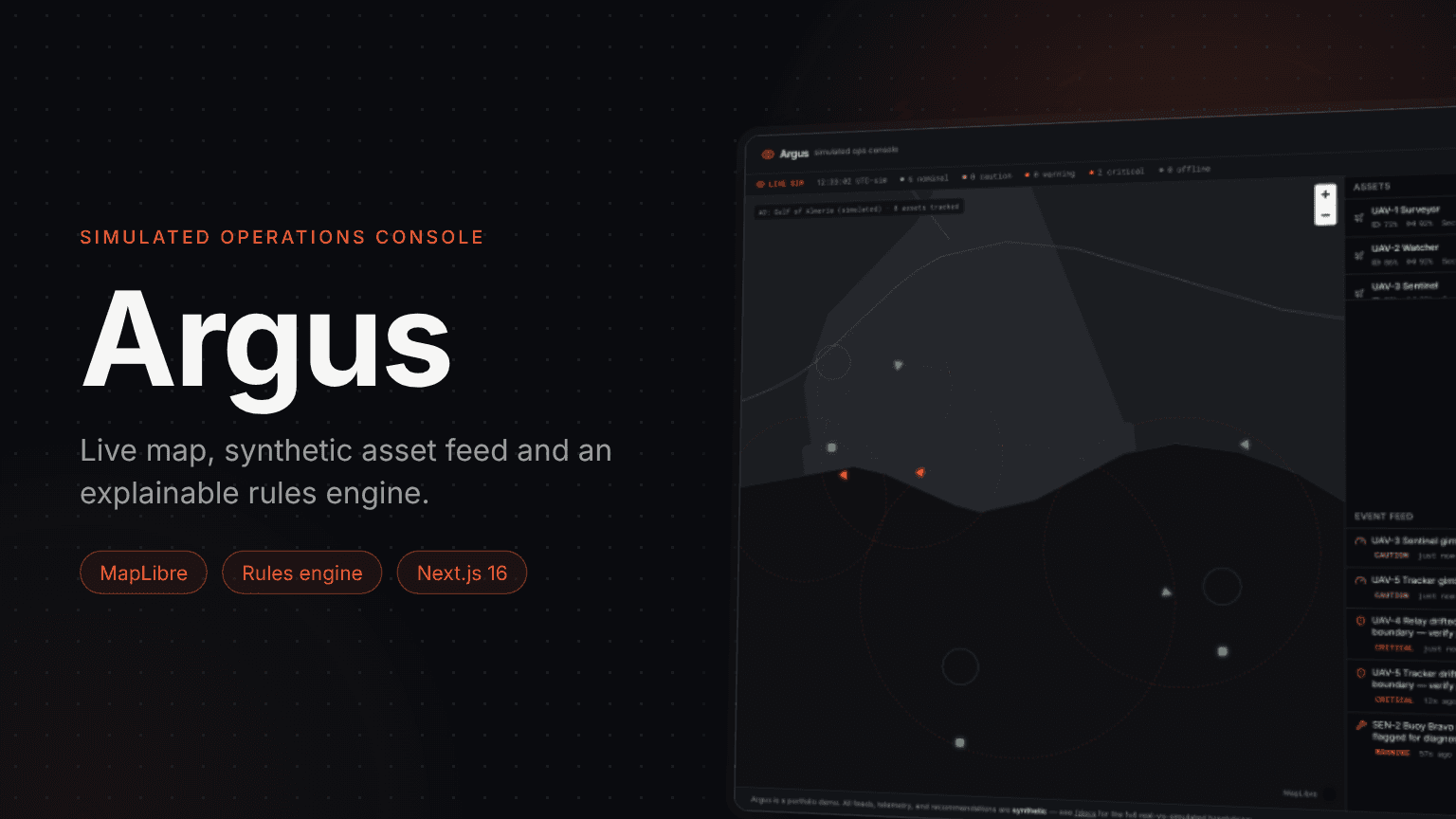
One dense operator screen: a live map with moving assets, a status bar, an asset list, an event feed and a panel of recommended actions, each one showing the rule that produced it.
Role
Design & Direction
Stack
Next.js, MapLibre, TypeScript
Built by
Remote cloud agent
Identity
Signal red · Inter
1. Overview
Named for the hundred-eyed giant of Greek myth, Argus fuses many simulated eyes, five drones and three fixed sensors, into one picture. It is the fifth and last satellite of Siegfried.
Every feed is synthetic and the app says so on every screen. It is inspired by the general shape of situational-awareness tools, not a specific product, and its events are framed as operations and logistics (verify a position, recall to recharge, dispatch diagnostics), never as anything resembling targeting.
⚠️ The Problem
An operator watching many assets at once drowns in signals. A suggestion system helps only if the operator can see why it suggests something; an opaque "AI says so" gets ignored or, worse, trusted blindly.
✓ The Solution
Explainable rules over a live picture. Four if/then rules rank the actions every tick, and each recommendation names its rule and cites the exact numbers that triggered it.
2. The Console
Map first, with docked panels: the structure comes from MarineTraffic's redesign, the dense telemetry panels from NASA's Open MCT, and the near-black surfaces with a single reserved accent from Grafana's dark theme. Everything is visible and moving at once, on purpose.
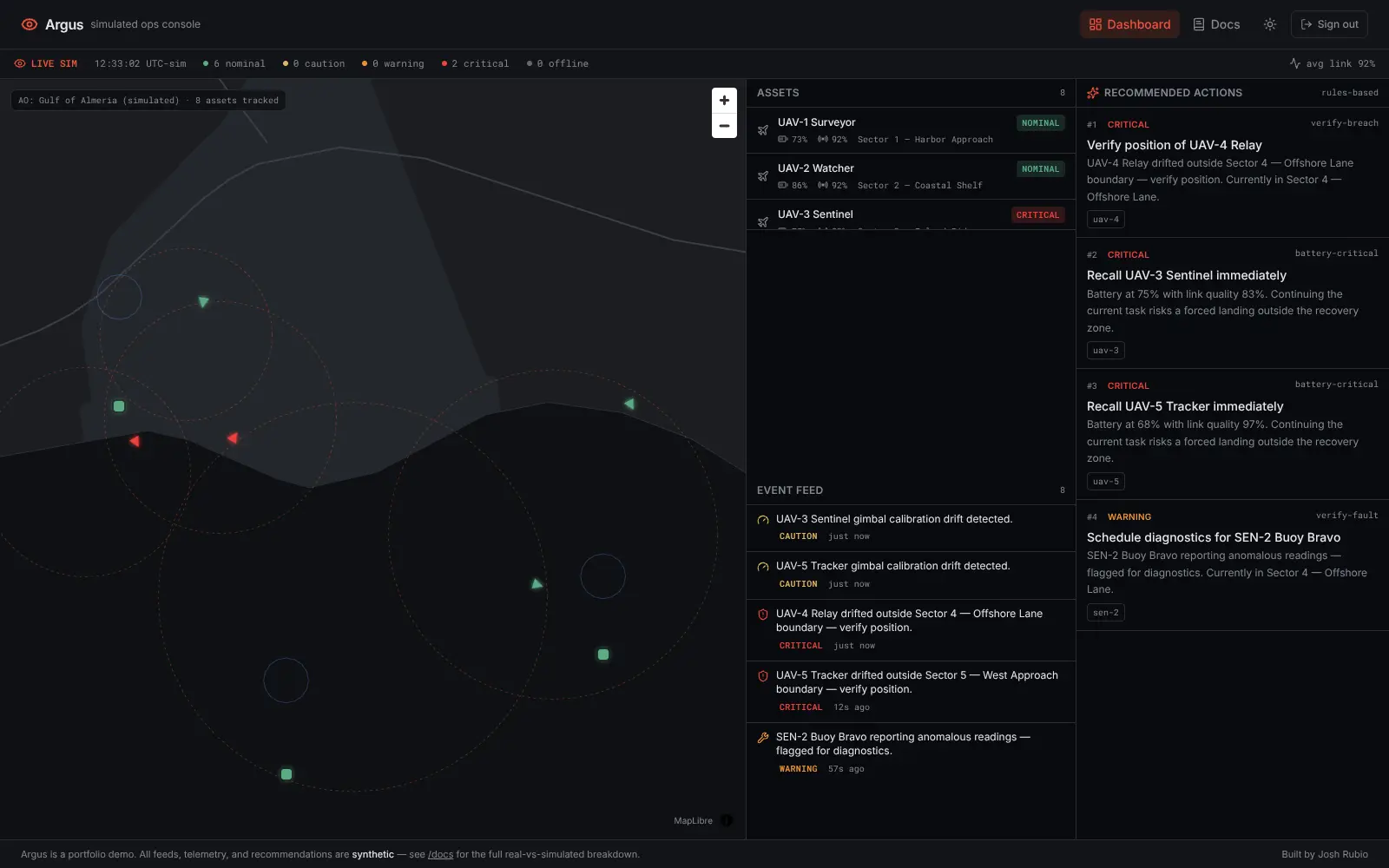
Status bar: Simulated clock, counts by severity and average link quality.
Map: MapLibre over the coastline near Almería, with patrol orbits and sensor ranges.
Assets: Battery, link quality, sector and state for every asset.
Event feed: Geofence drift, low battery, link loss, sensor faults, calibration drift and weather.
Recommendations: Up to six actions, ranked, each with its rule and the assets involved.
3. The Engine
There is no WebSocket server and no database. A browser interval advances a seeded simulation about once a second, events are drawn at low and tunable probabilities, and the rules are evaluated against the new state.
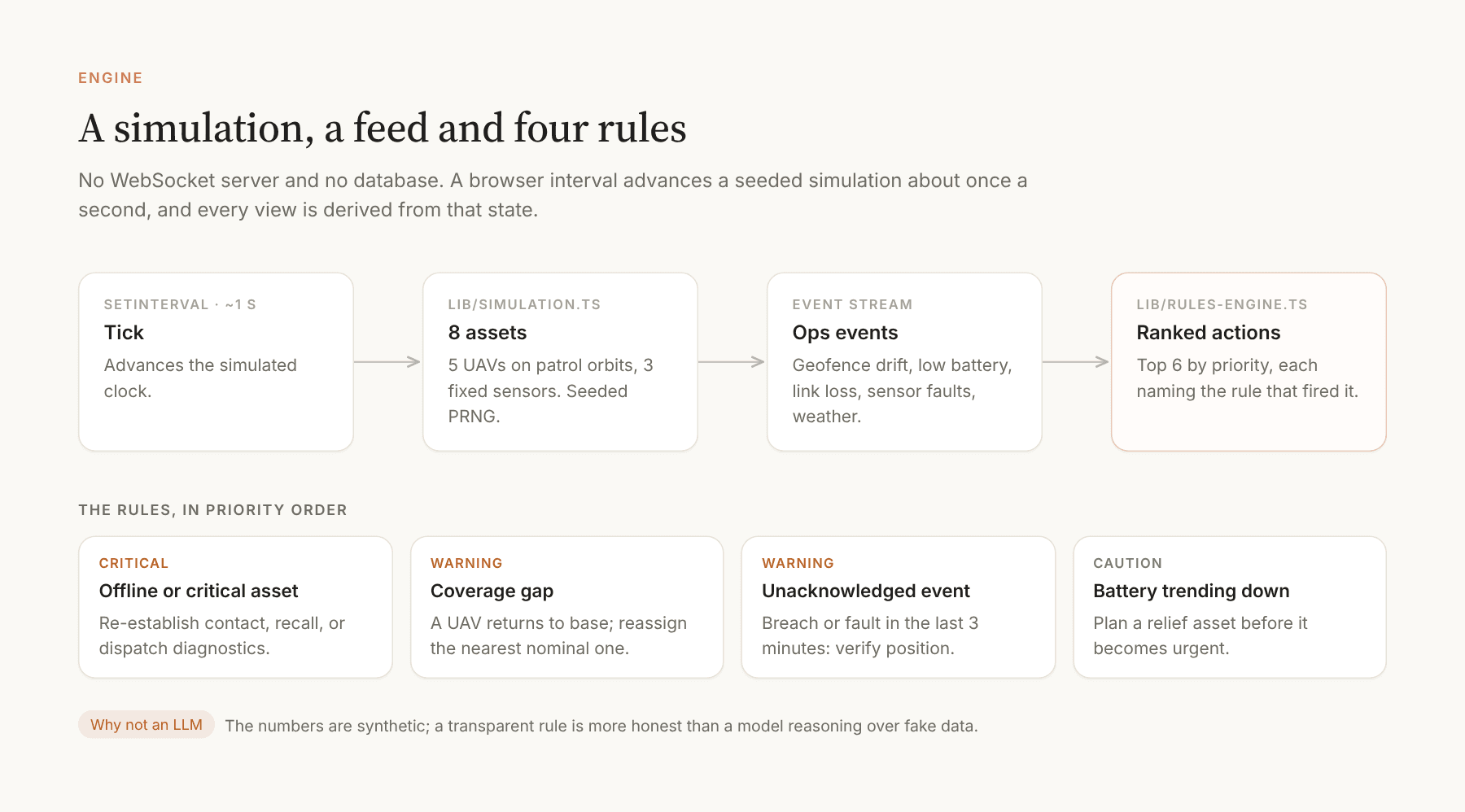
| Rule | Fires when | Suggests |
|---|---|---|
| Critical asset | An asset is offline or critical | Re-establish contact, recall or run diagnostics |
| Coverage gap | A drone returns to base or drops out | Reassign the nearest nominal drone |
| Unacknowledged event | A breach or fault in the last 3 minutes | Verify position or schedule diagnostics |
| Battery trend | A drone on task reaches caution level | Plan a relief asset ahead of time |
Why not an LLM
A model reasoning over numbers that are already synthetic would only add a layer of pretend intelligence. A transparent rule is more honest, needs no API key and is easy to audit.
4. Built by an Agent
Argus is the only satellite I did not build in my own session. I dispatched it to a remote Claude Code agent with one self-contained brief: the benchmark-first process, the Next.js 16 pattern, the demo auth gate and every gotcha already recorded in Siegfried's vault, restated inline because the remote sandbox could not read the vault. The agent researched, designed, built and pushed the repository; I then reviewed the live app, checked the framing of every event, registered it in Siegfried and wrote its spec.
The lesson: a brief that says "follow the usual pattern" fails silently in a remote agent, because there is no "usual" it can see. The playbook had to be complete enough to stand on its own.
5. Honesty Page
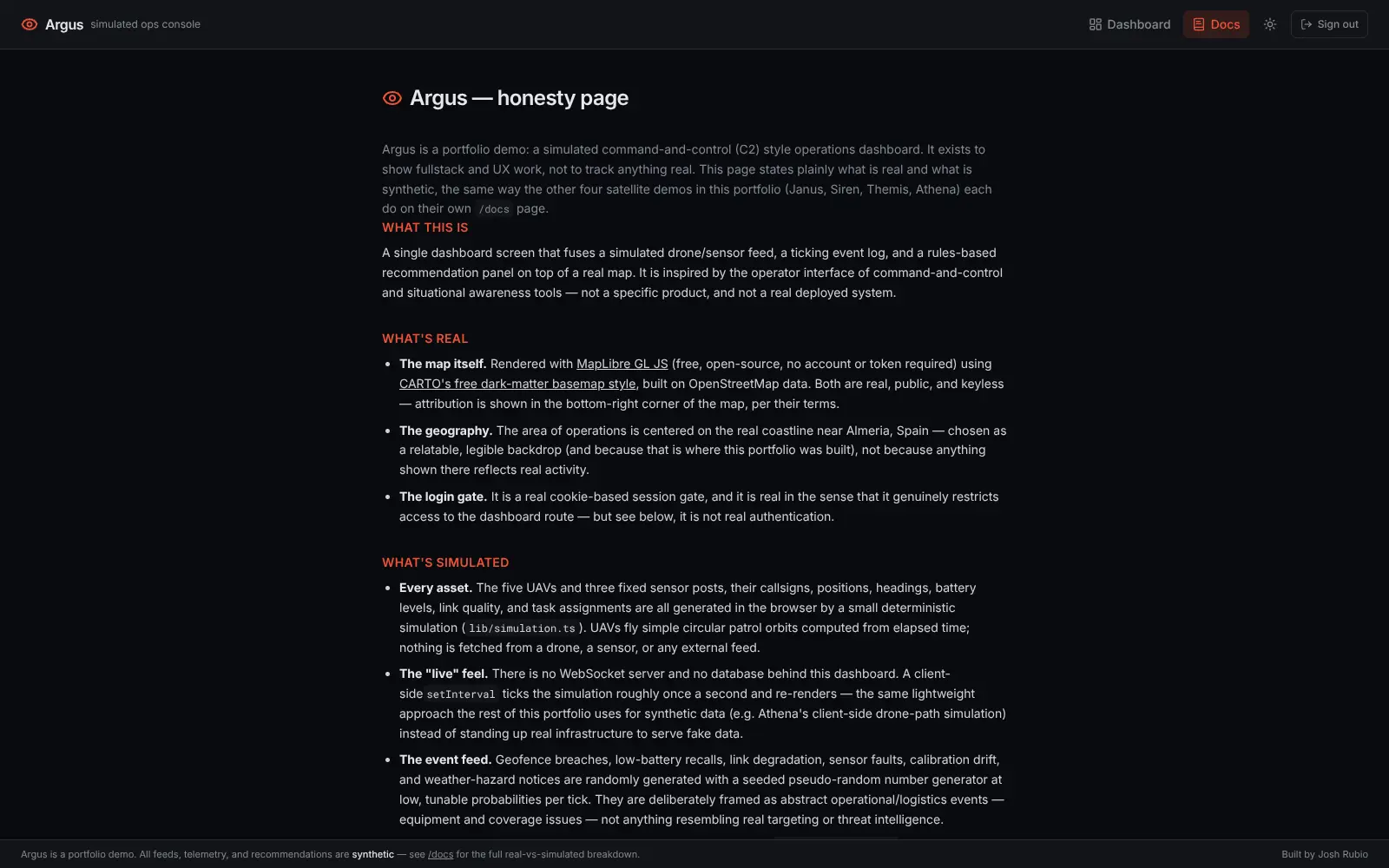
As in every satellite, a docs page lists what is real (the map, the geography and the login gate) and what is simulated (every asset, the live feel, the events, the recommendations and the login itself), along with the known limits of the simulation.
6. Outcome
8
simulated assets
~1 s
simulation tick
4
explainable rules
1
brief to a remote agent
Key Takeaways
- Explain every suggestion: Showing the rule and its numbers turns a recommendation into something an operator can check.
- Framing is a design decision: Neutral, logistics language kept a surveillance-style interface clearly an asset-coordination tool.
- Delegation needs a real playbook: The remote build only worked because the conventions were written down completely.
Next steps: A basemap that follows the light theme, and acknowledging events from the feed so rule three can be closed by the operator.