
Version 2 · November 2026 · rebuilt from the WordPress original
Carmen Zambrano - Journalist Portfolio
The digital home of a veteran journalist, rebuilt from a WordPress site into a static, trilingual Next.js portfolio with dark and light themes, and a clear door to the newspaper she founded.
Role
Design & Development
Client
Carmen Zambrano
Stack
Next.js, Framer Motion, GSAP
Languages
ES · EN · NL
1. Overview
This project has two lives. I first designed her portfolio on WordPress and Elementor. In November 2026 I rebuilt it from scratch as a static site, now on its own domain, carmenmazambrano.nl.
Carmen Zambrano is a social communicator with over thirty years in press, government and corporate journalism, radio and television. Today she lives in Rotterdam, works as an independent journalist and edits The New Paper. The portfolio has one job: let her story and her work take centre stage. This page starts with the current version and goes back to where it began.
2. Evolution
The first site did what a portfolio needs: a clear structure for decades of work (About, Portfolio, Blog, Contact), a clean look that reflects her authority, and Elementor so she could update content herself. What changed is the context around it.
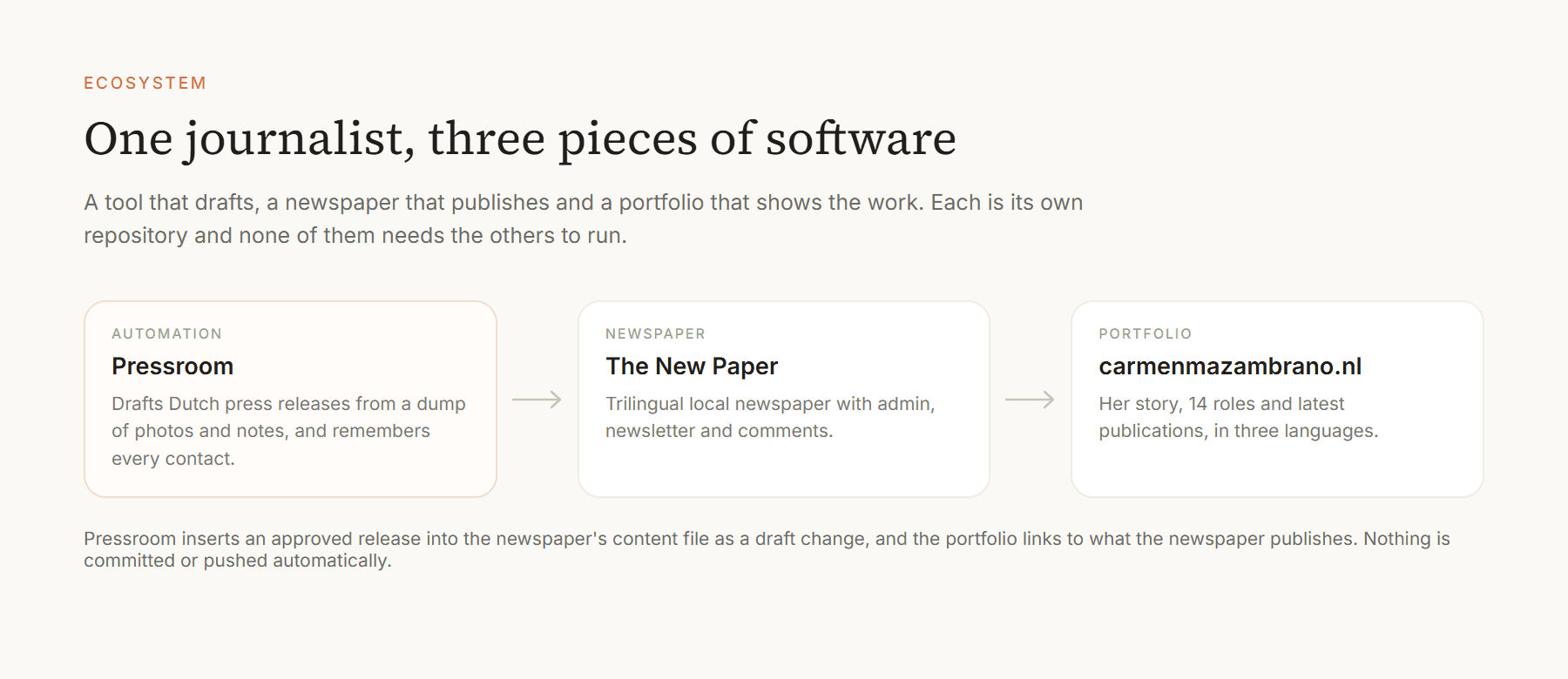
Her newspaper, The New Paper, started as a newspaper-style portfolio and became a publication of its own. That left the portfolio to be rebuilt as what it should always have been: a calm, fast, personal site that points to the paper instead of competing with it.
3. Goals of the Rebuild
⚠️ What the site needed to do
- Tell thirty years of work without overwhelming a visitor who has one minute
- Speak three languages: Spanish, English and Dutch, since she writes, works and lives across all three
- Point to The New Paper clearly, as her current work, without confusing the two sites
- Load instantly and need no database, no login and no yearly maintenance
✓ The approach
The words live in dictionaries, the facts live in one file. The page is generated once per language, so there is nothing to run on a server and nothing to hack.
4. Structure
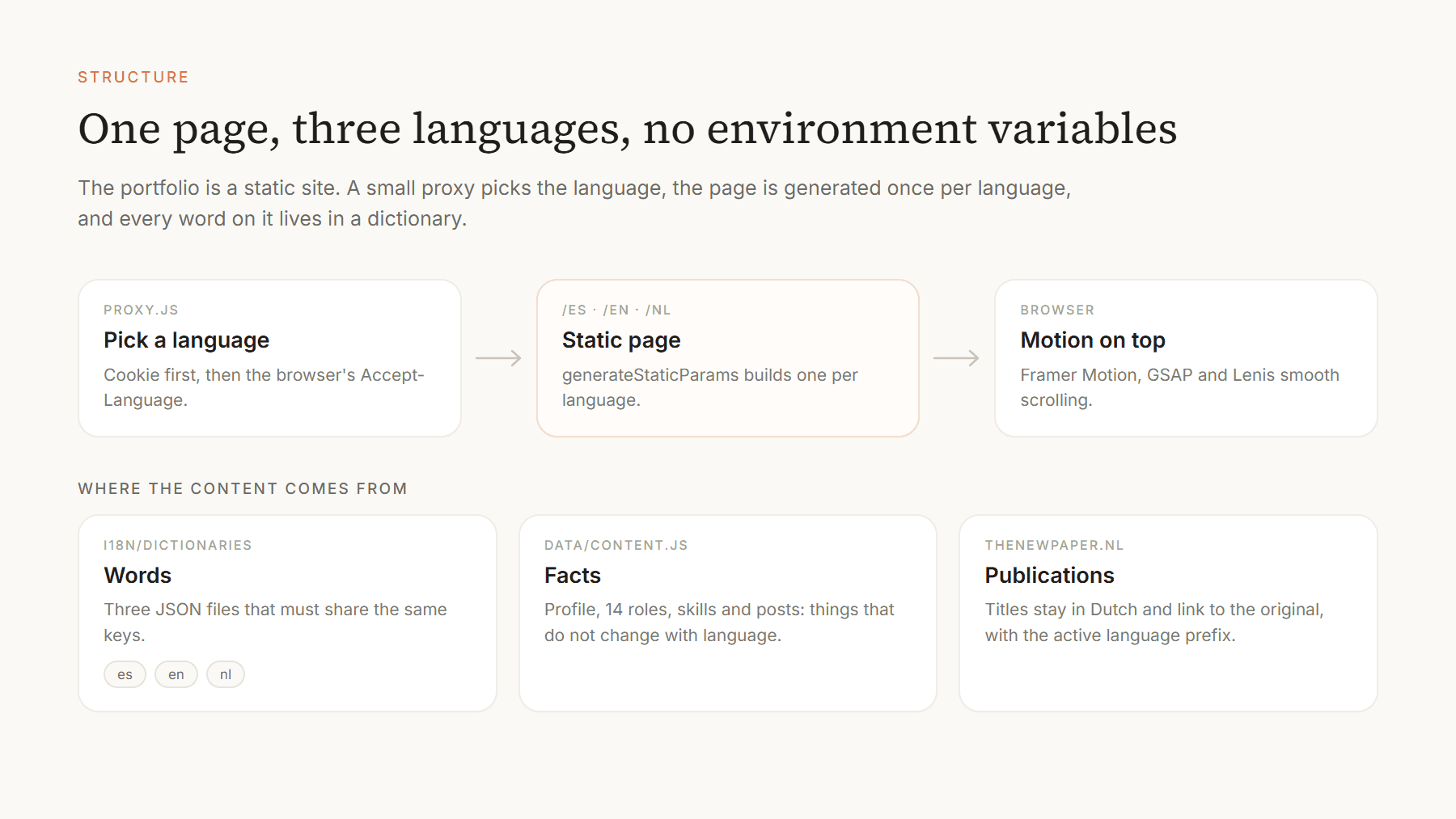
A small proxy picks the language from the visitor's cookie or browser setting and redirects to /es, /en or /nl. Each is a static page. Texts come from three dictionaries that must share the same keys, and everything that does not depend on language, such as roles, dates and skills, lives in a single data file. The site needs no environment variables to deploy.
5. The Page
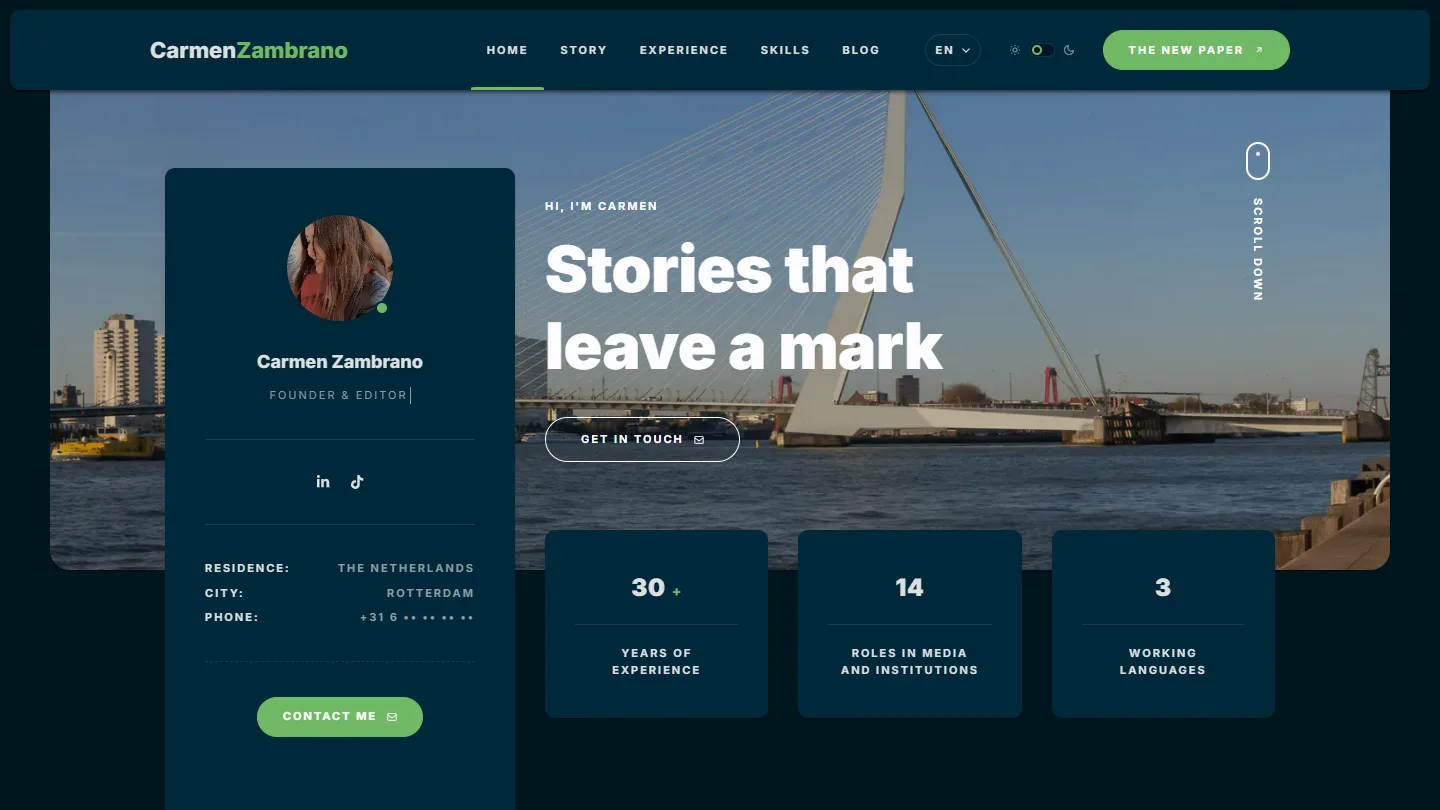
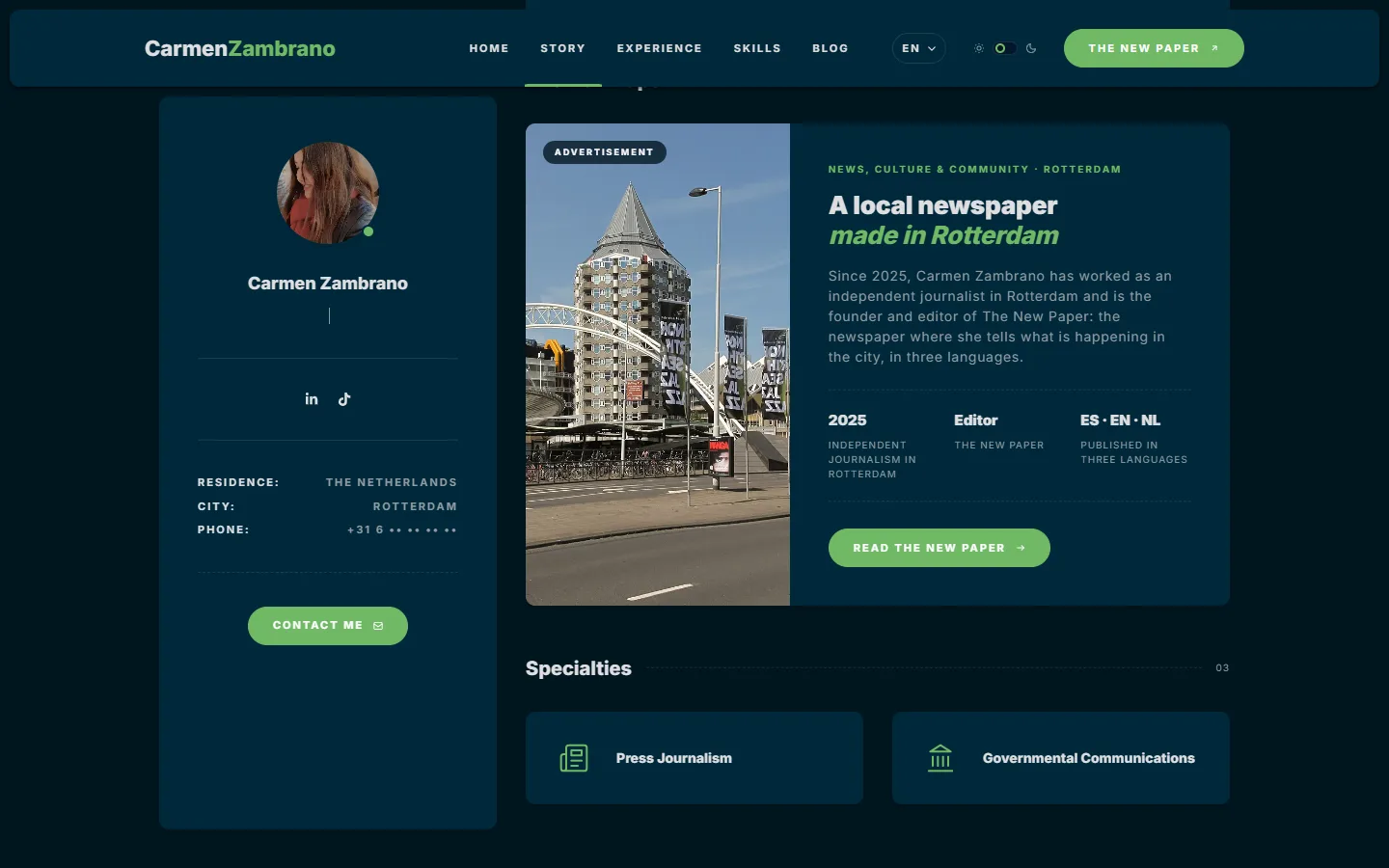
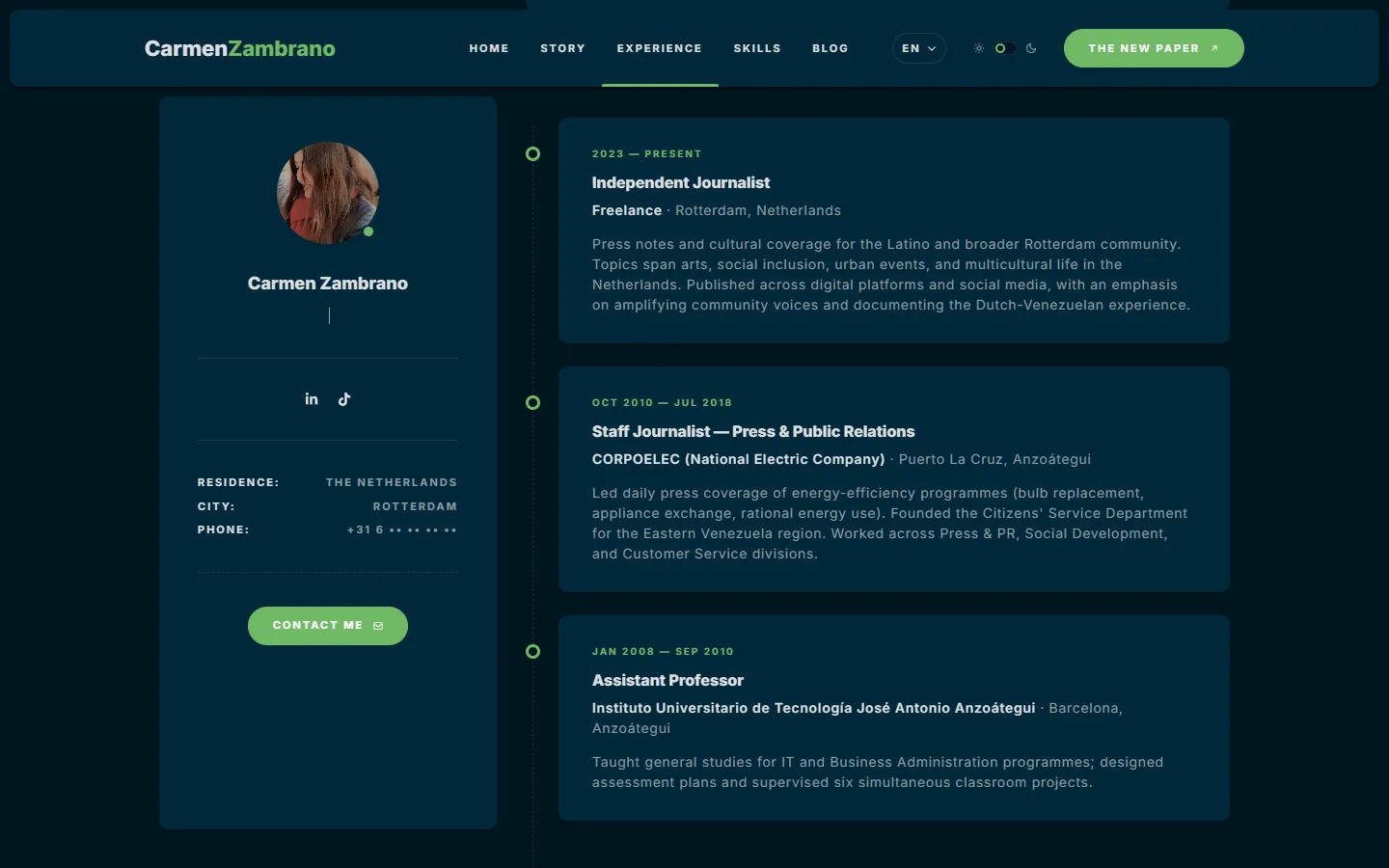
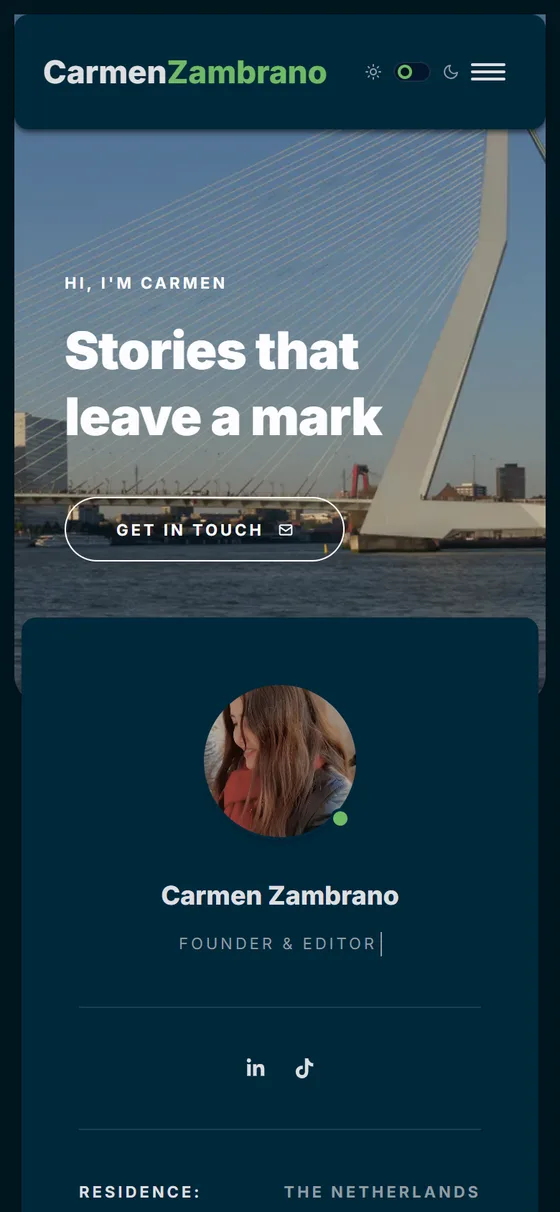
One long page with five anchors: Home, Story, Experience, Skills and Blog. A profile card sits beside the content on desktop and moves above it on a phone.
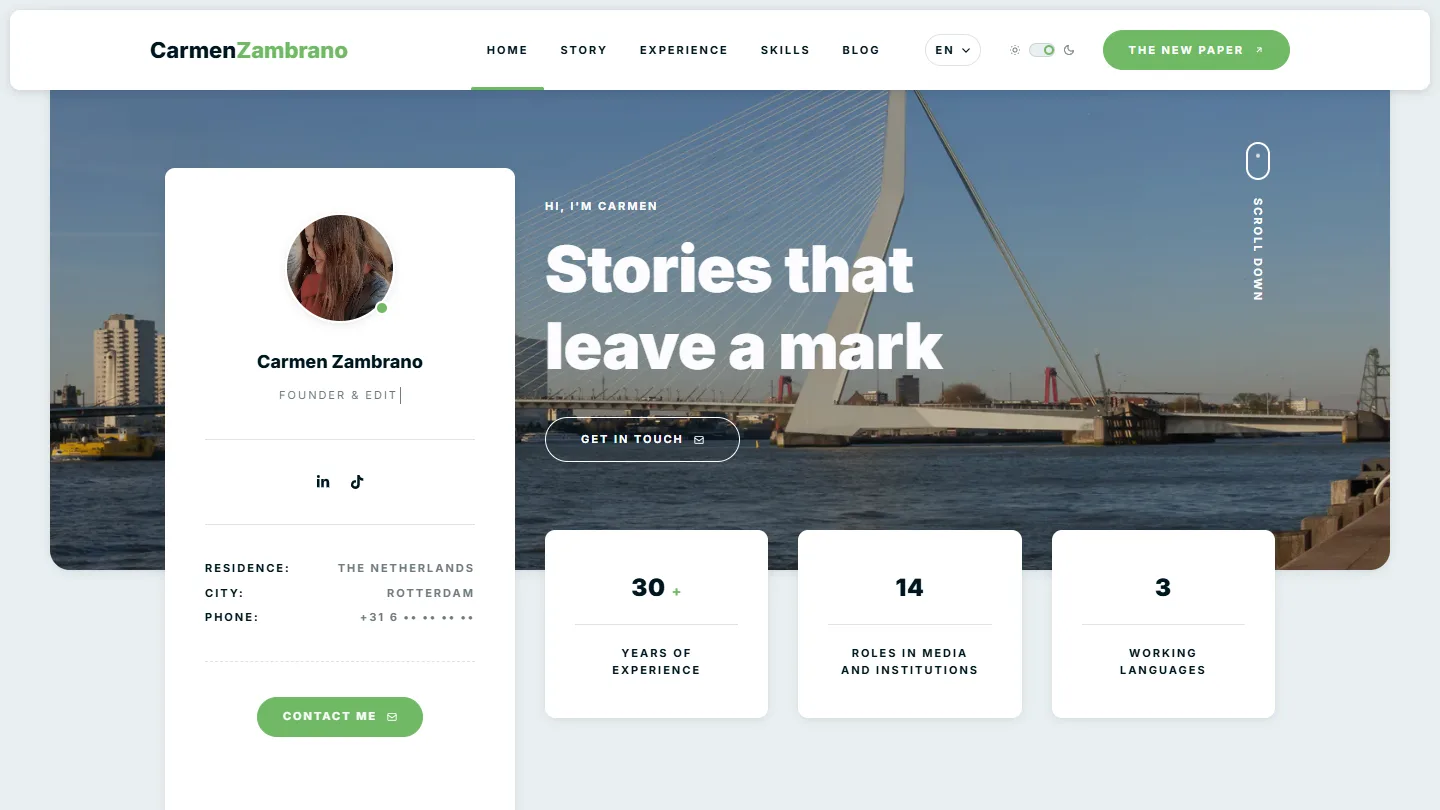
Hero and counters: A photograph of Rotterdam's Erasmus Bridge, served at two sizes, with three numbers that summarise a career: 30+ years, 14 roles, 3 working languages.
The New Paper: A card, labelled as an advertisement, that presents the newspaper and links to it.
Experience as a timeline: Fourteen roles from a radio station in 1993 to independent journalism today, each with place, period and a short description.
Voices from the newsroom: A carousel of quotes about published articles.
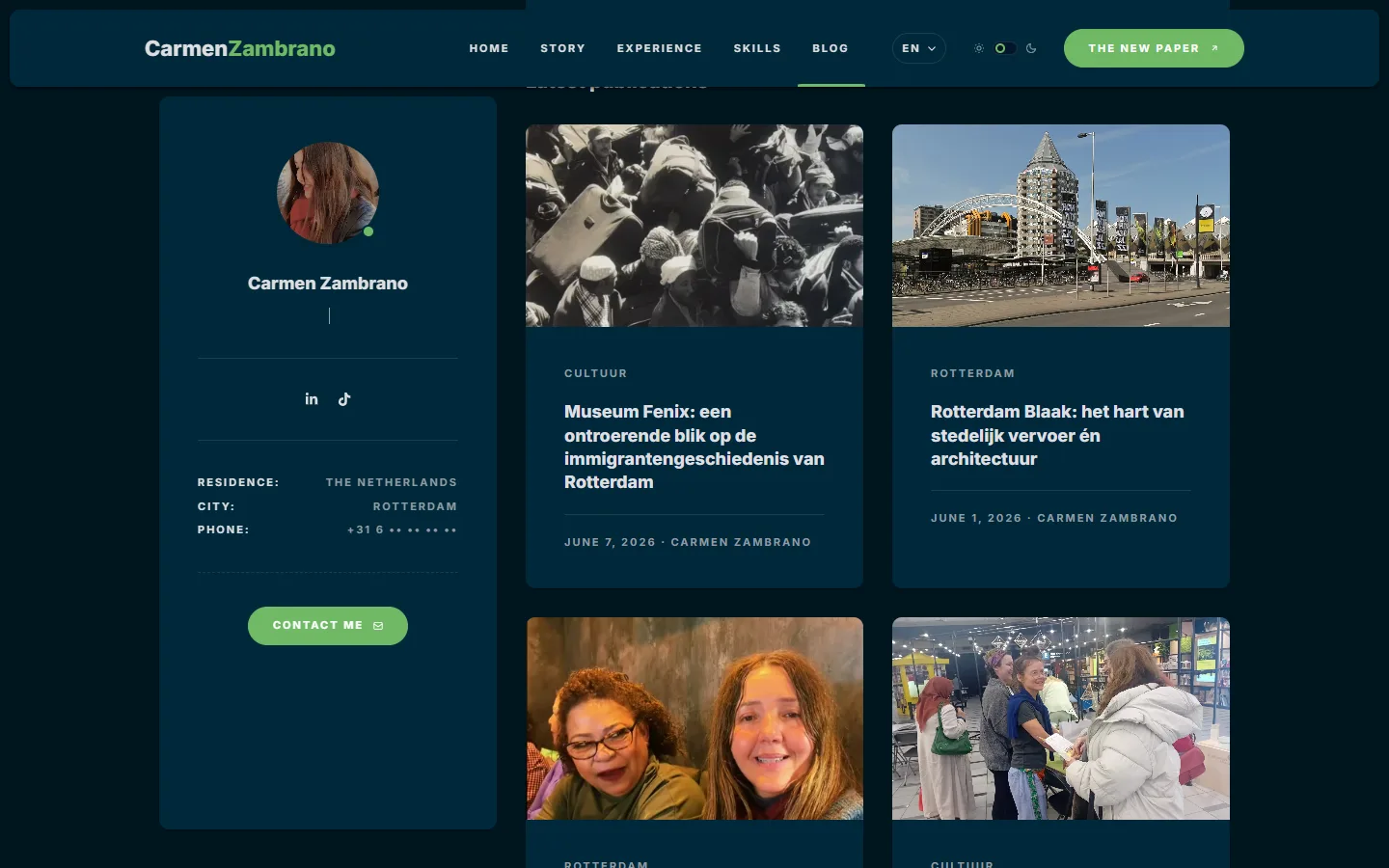
Latest publications: Four recent articles with their original Dutch titles, linking to the paper.
6. Motion and Themes
The site is dark by default, with a light theme one click away. The choice is remembered in the browser. Motion is a layer on top of content: sections reveal once as they enter the screen with Framer Motion, GSAP and ScrollTrigger animate the hero title and its cover photograph, and Lenis smooths scrolling and anchor jumps. A short preloader plays on the first visit of a session and is skipped afterwards.
7. Languages and Search
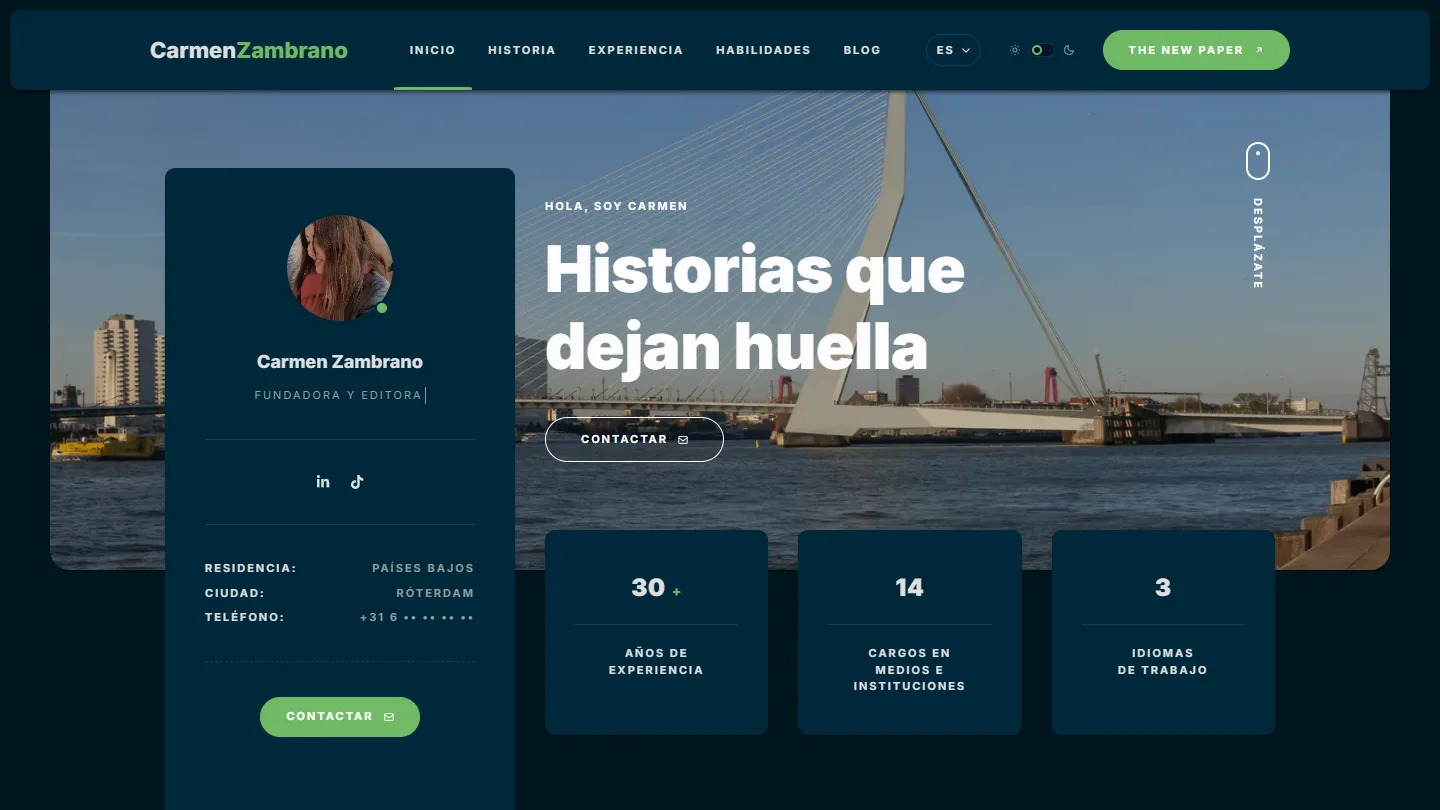
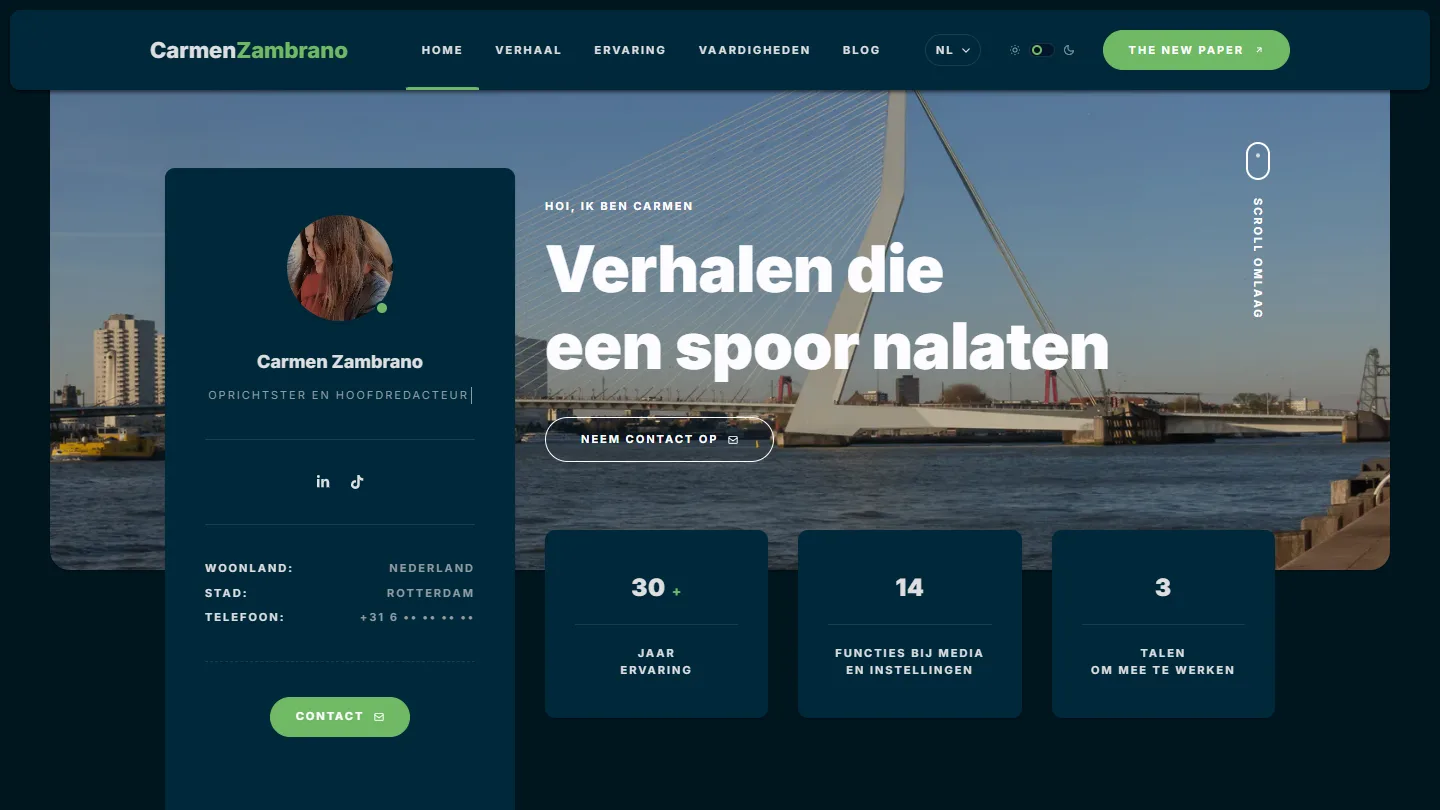
Same keys in three files: Spanish, English and Dutch dictionaries are edited together, so no language can quietly fall behind.
Article titles stay in Dutch: The articles are published in Dutch, so titles are not translated and the link carries the visitor's language prefix.
Search and sharing: Per-language metadata and alternates, a sitemap and robots file, structured data for the person and her newspaper (with no email or phone in it), and a share image.
8. Key Decisions
Files instead of a page builder
Elementor let Carmen edit her own page. The rebuild gives that up on purpose: the content is stable, and a file in git is faster, safer and free to host. The cost is real, since a change now goes through me, and that is acceptable for a portfolio that changes a few times a year.
Static pages, one per language
Generating the three languages at build time means no server work per visit and no runtime translation. Adding a fourth language is a dictionary and a line in the configuration.
Two sites, two jobs
The newspaper is a product with a console and a mailing list. The portfolio is a person. Keeping them apart lets each one stay simple and lets the portfolio link to the paper as her current work.
9. Outcome
3
languages, one page each
14
roles on the timeline
30+
years of work told
0
databases or environment variables
10. Role
Version 1: Information architecture, visual identity, WordPress and Elementor implementation, and a responsive reading experience, alone.
Version 2: The rebuild: the design, the three dictionaries, the motion, the themes, the search metadata and the deployment, alone.
Key Takeaways
- Rebuild when the context changes: Version 1 was not wrong. A newspaper of her own changed what her portfolio had to be.
- Give up editing deliberately: Trading a page builder for files is a good deal only when the cost is named and accepted.
- Keep motion on top of content: The page reads fully before anything animates.
Next steps: Respect the reduced-motion setting across every animation, and add her latest articles automatically from the newspaper.